Wednesday, 28 October 2015

Appreciation & Farewell Lunch from Sembawang Town Council

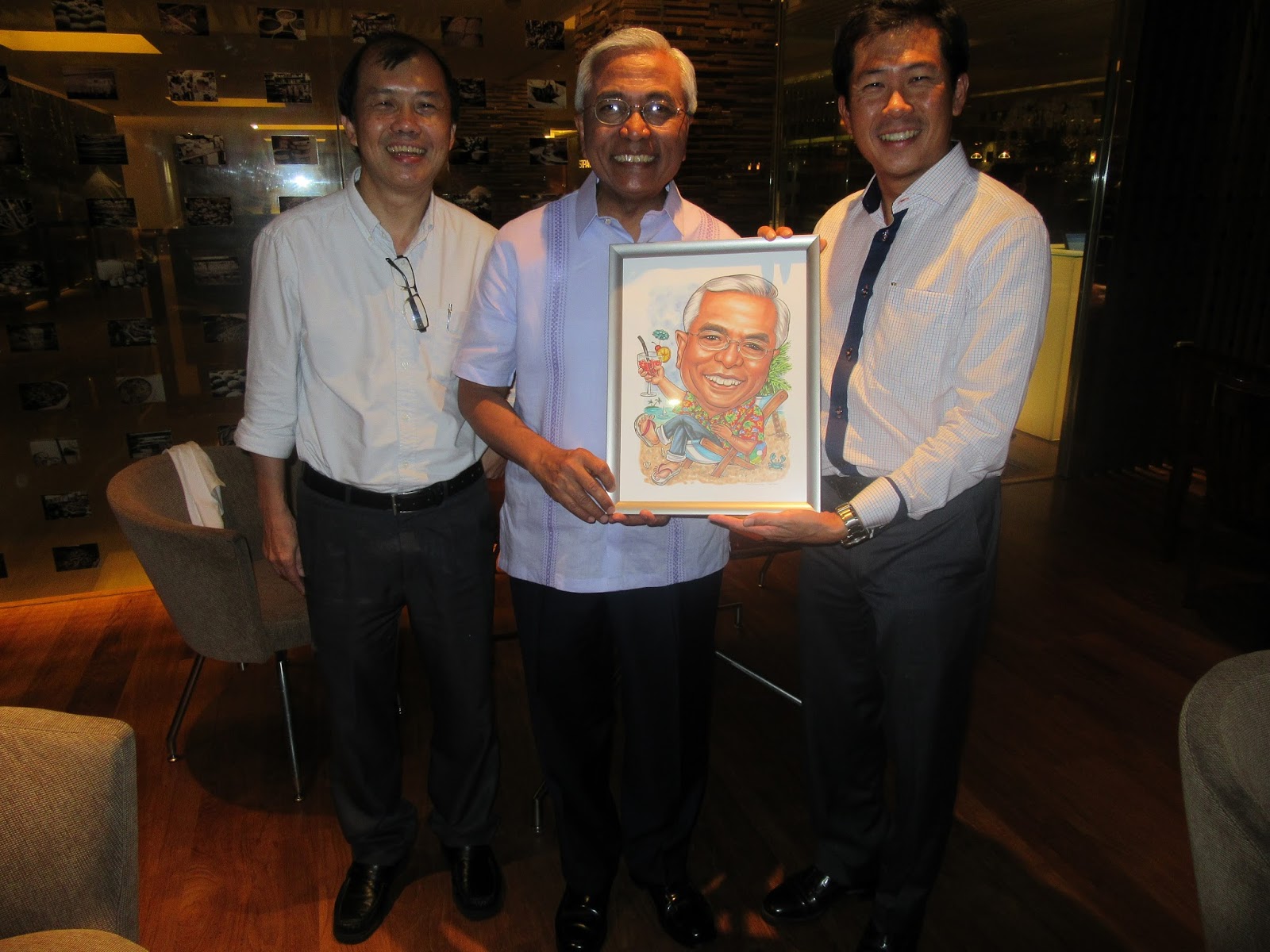
Attended an "Appreciation cum Farewell Lunch" for Mr Hawazi Daipi at The Straits Kitchen in Hyatt Hotel yesterday. It was organised by Mr Soon Min Sin, General Manager/Secretary of Sembawang Town Council. He invited all the managers including Mr Terence Chan, General Manager/Secretary of Yishun Town Council to join Mr Hawazi Daipi, former Chairman of Sembawang Town Council for the lunch. Also received from the CEO of EM Services, Mr Tony Khoo on the caricatures of Mr Hawazi and myself at the lunch.


Sunday, 25 October 2015

CCC 50th Anniversary Dinner!

I was invited to the CCC 50th Anniversary Dinner at PA HQ last Saturday. PM Lee was the GOH. He spoke in Mandarin and English. In his speech in Mandarin, he used the metaphor "Depth, Broadness and Thickness" in engaging the community. In his speech in English, he used the acronym 3Ps - Purpose, Priority and People in connecting the community. He hoped the CCC could take the lead in reaching out to the other interest groups including the clans, arts and culture. About 1,600 grassroots leaders attended the function.


Sunday, 18 October 2015

Book Launch on PAP Pioneers

Attended the book launch on PAP Pioneers: 50 Ordinary Stories at The Clifford Pier, Fullerton Bay Hotel this morning. PM Lee Hsien Loong was the Guest of Honour. Speaker of Parliament, Madam Halimah Yacob was the Organising Chairperson. She is also the PAP.SG Chairperson. The 2 DPMs were also special guests at this morning's book launch. In his key note address, PM Lee mentioned about The Clifford Pier, the difference between the old and new setting. It helped me to reminisce that when I was a small boy, about 10 years old,  my father brought me to Kusu Island. At that time, Clifford Pier was a jetty where wooden boat (tongkang) would ferry passengers to the southern islands including Kusu Island. I was seasick and vomited overboard because the sea was choppy and the diesel engine was belching fume towards my direction. I had nausea and vomited profusely. My only consolation on the trip was rewarded when I saw clear water with fishes swimming around the boat. I could see the bottom of the seabed when the boat was nearing the island. It was my first venture out in the sea on a boat. A journey brought back fond memories of my younger days at this morning's book launch.  


Monday, 12 October 2015

Cost of Living

Cost of living has been a controversy and is hotly debated  in public and in Parliament. Oppositions will use the platform during the General Election to argue and stir the emotion of the constituents. It is not only a local issue but a global phenomenon. It is about the standard of living as we become more affluent. When we talk about the cost of living, people generally want to compare the disparity in income between the rich and the poor and their spending power. It is only natural  as we progress and prosper as a nation, the income rises especially for those who are more qualified and experienced. With higher income, the expectations on their lifestyle also increases. No wonder many successful younger professionals and executives want to enjoy and have the 5Cs - cash, credit card, car, condominium, and club membership. It is the aspiration and envy of younger generations.
 
What is exactly the cost of living all about? Is it about the bread and butter issue or is it about rapid rising cost of living expenses? Responsible government will take constructive measures to cap and control on the rising cost. Government has the responsibility to leverage the income of the bottom end of the population. As lasses-faire (free and open) economy, the government cannot control on the disparity on the income of individuals especially those who are better qualified and experienced. The market forces will determine on the salary scale of the more able and compensate those who have special skills and abilities. 
     
The government can intervene by controlling on the inflation by strengthening on the currency since most of our consumable goods are imported from overseas. The stronger dollars can lower our import cost and, hence, pass on the savings from the exchange rate to the consumers. Government can also encourage fair and open competition by forming co-operative stores or supermarkets so that it gives the consumers the choice where to shop and buy their goods at lower prices. The government can consider giving grants, subsidies and rebates on the municipal services, including rental and utilities if there are surpluses on the budget from the thriving economy. The best measure and to create long term impact, the government can consider giving bursaries and scholarships to those who excel and perform outstanding in their studies. For adult workers and learners, the government can support with incentives to encourage them to upgrade and go for training. Government can help them with job placement if they are retrenched or change of career after they have acquired new skills. However, in desperate and worst scenario cases, government can give interim financial assistance to help them tie over the difficult period, such as, retrenchment or complete loss of income if they are sole breadwinners.
 
While the government can do their part to help and relieve the financial woes of the unemployed or lower income earners, it is nothing better to be self reliance. The worker must be prepared to go for training and upgrade their skills and abilities. They must cultivate the learning habits and become a lifelong learner to stay relevant and employable. They must change their attitudes and cultivate in them the values of hard work, honesty, work discipline, determination, commitment, sense of responsibility and perseverance in overcoming challenges. They must believe and build the confidence in themselves to have self esteem. Ultimately, they must live their own life and be accountable to themselves and that no one owe them a living. In Jack Neo's film "Money Not Enough" only reveals the reality and practicality of every day's life. One must lives within their mean no matter what is their income. Most important of all, they must prepare to work and ask themselves what they should do to increase their earning capacity.
 

Friday, 2 October 2015

HDB - Public Housing

When we became Independent in 1965, Singapore was a third world country with underdeveloped economy. There were massive unemployment, shortage of schools and poor housing with lack of facilities.
 
With swamp and slump shanties, the government began to resettle the villages and farmers. When the fire razed through the squatters in Bukit Ho Swee, the government speeded up the process in building new flats to house the homeless caused by the fire.
 
I witnessed the transformation of Singapore landscape from rural village in the 50s and 60s to urbanised satellite new town in the 80s and 90s. Singapore became a metropolis today with infrastructure and facilities of the first world.
 
It was the promise and priority of the government to provide permanent shelters for all Singaporeans. It was not only a shelter but affordable housing. It was the dream of home ownership that the government started with the public housing programme. Under the HDB (Housing and Development Board), the government started with low cost housing programme speedily. It was with remarkable result that 90% of the population bought and stayed in subsidized public housing.
 
With better trained architects and engineers, the HDB started to improvise with town planning. They built with better design and quality finished materials. HDB allows buyers to tap on their CPF savings to pay for their flats. HDB also help to provide direct housing mortgage loan and give grant to the first timers and for children to buy their own flat and stay close to their parents.

The investment in an asset on public housing gives security and protection to the aged and retired Singaporeans. The asset can be converted to cash in time of emergency. Some out of desperation, cash-in and sold their HDB flat to pay for their medical bills or debts. However, some would take advantage on the inflated value and cash-in on their HDB flat. They would squander their money from the sales proceeds and spent lavishly on their lifestyle or satisfied their desires.

Actually, there are alternatives or solutions to get some reliefs from their existing HDB flat. One is to sublet one of the rooms to collect monthly rental to support their livelihood. Two is to down-grade to a smaller unit or buy a studio apartment, if they are eligible, and keep the balance of the cash from the sales proceeds to support their living expenses. Three is to consider the "Buy Back Scheme" if they meet the HDB's criteria (age and size of the flat). It must be the last resort to sell their HDB flat. An important factor many residents neglect or ignorant is to pay the levy when they sell their flat and later wish to buy a HDB flat for second time. Many will cash-in and use the money from the sales proceeds for other purposes. They later found that they are eligible to buy the HDB flat for second time but they do not have cash to pay the levy they owe to HDB. Normally, the amount is substantial and can be thousands of dollars.

In the last National Day Rally, PM said that MND is working on "Fresh Start" to give those who have previously bought twice the HDB flats another chance to buy and own a new HDB flat. However, there would be criteria attached to the "Fresh Start" scheme so that buyer cannot abuse the system. One effective way is to control on the resale of "Fresh Start" flat. The owner can only sell back the "Fresh Start" flat back to HDB at their original purchased price.

HDB flats are heavily subsidised and it is only fair that HDB imposed levy on the re-sales of flat. Also some might have received grant from the HDB at the time of their purchase and again, it is only fair they pay back the grant when they sell their flat. If one compare the HDB public housing to a private condominium, the difference is vast and it can be as much as 5 times or more on the purchase values, depending on the location, design and size (floor area) of the private unit.

Sunday, 27 September 2015

CPF Part 2

In my earlier blog, CPF Part 1, I explained it from my personal perspective (micro view). I shared and highlighted how I have enjoyed and benefitted from the policy and CPF scheme. It was like buying an insurance that gives me protection and return with dividend on my premium.

It is mandatory for employer and employee to contribute towards the CPF accounts. The employer has to match and contribute near proportion to the employee's CPF account. Currently, the employer contributes about 16% and employee about 20% of the monthly gross salary. It adds up quite a substantial savings for working Singaporeans.

CPF is a social safety net. It allows retiree to withdraw monthly from their CPF savings to support their livelihood especially for the middle and lower income group. The amount to be withdrawn per month will depend how much savings there are in the individual's retirement account. Retiree can still continue to enjoy on their health care by tapping on their Medi Save fund to pay for their hospital bills. The Medi Shield Life can provide long term health care for their medication and hospitalisation especially those with chronic disease or illness. For those who have lost their income or their savings in the CPF have depleted, they can apply through Medical Social Worker for Medi Fund to pay for their medicine and hospital bills subject to a mean test. CPF allows Singaporeans to buy and own their home, either public housing (HDB flat) or private property (condominium or landed houses). The asset can be converted to cash in time of emergency.

I shall now explain in macro view on what happen to our money when deposited in the CPF. The government under the Ministry of Finance (MOF) becomes the trustee. MOF have to guarantee on the payment including annual interest when the time is due. The money deposited with the CPF Board would be divested and reinvested through GIC (Government Investment Companies) and Temasek Holdings to generate revenue and growth. Like any business, there is always risk on the investment. There would be gain and loss. Spread over time, GIC and Temasek Holdings must earn with surplus to repay the capital sum deposited with the CPF Board plus dividend to the depositor in due course.

Like any financial institutions, banks and stock exchange, they must have the public's trust and confidence in order to operate and perform with results. Any banks or finances will become insolvent or goes bankrupt if they lost the trust and confidence of their customers. Likewise, MOF and CPF Board can only perform to its optimum and earn sound return if the depositors have faith and confidence in them. This is the reason why we must have people of highest integrity and competency to manage our national wealth including our reserved fund.
 
We must be grateful to our pioneer leaders and founding fathers especially our former DPM and Finance Minister, Dr Goh Keng Swee, for initiating and implementing CPF savings in our work force. CPF money allowed to be circulated and distributed in our economy. It is a prudent and measured policy which works for Singapore.
 
It was coincident that at the time of my writing this blog, I was reading "The Second Curve" by Charles Handy. He mentioned in his book on page 146 chapter 10 under the Ponzi Society and praised Singapore on the Central Provident Fund. 

Thursday, 24 September 2015

CPF Part 1

CPF (Central Provident Fund) is the basic theory of economic. It is about saving a part of your earning. It is also about compulsive saving. A lifestyle habit, to be thrifty and frugality cultivated from young and introduced from working life.

CPF is a traditional colonial rule inherited from the British. It is a social safety net for old age and retirement. Over time, the Singapore government improvised it and changed the rules to allow CPF savings as part of long term investment giving bigger and more secure return. This was the reason CPF savings can be used to buy public housing (HDB flat) and private properties. In recent years, it also allowed to use CPF savings to invest in government approved (blue chips) bonds, stocks and shares to earn higher return.

Lately, the CPF Board allowed elderly or retired Singaporeans to deposit part of their total CPF savings to CPF Life to earn higher interest and to be withdrawn on monthly payment for a life time just like the annuity scheme. In other words, one receives a sum of money to support their daily expenses and livelihood.

I have benefitted from this policy of CPF scheme. It allows me to buy my first HDB flat from my CPF savings. Although my basic salary was low when I started working and monthly contribution to the CPF was not much, I do not have to pay cash and incur financial burden in repaying the monthly instalment. With low purchased price for a 5-room point block flat at the time, I was able to repay the mortgage loan in a short few years. The employer's CPF share of contributions played a crucial part in both savings and instalment repayment scheme. I later sold the HDB 5 room flat and invested the total sales proceeds in a private property.

The CPF scheme has provided me with a permanent home but also gives me a good return on my assets. Both the HDB flat and private property bought appreciated in value and gave me a good return on my investment. All these were possible with my savings in the CPF when I started working.

When I started my own business, I continue to contribute to the CPF under self- employment. It allowed me to accumulate my CPF savings and I was able to buy and re-invest in other properties. It also allows my savings to grow and earn good return in term of interest and appreciated values in assets.